
Simple Fine Motor Activities for Toddlers and Preschoolers (Ages 2–4)
Affiliate and Referral links are used below to promote products I love and recommend. I receive a commission on any purchases made through these links. Please see my disclosure policy for more details. As an Amazon Associate, I earn from qualifying purchases.
Fine motor skills are built through simple, hands-on play during the early years. Below you’ll find easy fine motor activities that support skill development for children ages 2–4.
If you’re wondering what skills are typically developing at this stage, be sure to check out my Age-Appropriate Skill List for Ages 0–6 as a helpful reference.
Keep in mind that all children develop at their own pace. These activities are meant to support growth through everyday play, not pressure or perfection.
Fine Motor Activity Ideas for Ages 2-4
Below is a general overview of skills children typically work on between ages two and four. Next to each skill, you’ll find simple, hands-on ideas to help support development through everyday play. Remember—these are guidelines, not a checklist. Children develop at their own pace, and playful practice goes a long way.
Activity Ideas Ages 2–3 Years
Strings large beads
Use large beads or chunky items that your child can easily grasp. Encourage them to pick up beads using their thumb, index, and middle fingers to begin developing a pincer grasp.
Try this:
- Thread pool noodle slices, large pasta, or cardboard shapes
- String cereal or fruit loops on pipe cleaners
- Slide rings onto a paper towel roll held vertically
Snips paper with scissors
At this age, the goal is exposure—not precision. Focus on opening and closing the scissors.
Try this:
- Snip play dough or straws
- Cut fringe into construction paper
- Create a simple collage using colors, shapes, or stickers
Rolls clay or play dough into a “snake”
Rolling strengthens the hands and builds coordination.
Try this:
- Roll “snakes” and bend them into letters or shapes
- Press the dough flat and poke with fingers
- Use cookie cutters or plastic utensils to cut and poke
Draws and copies a horizontal line
Always model first and keep language simple and consistent.
Helpful cues:
- “Straight line down”
- “Across” (left to right)
Try this: - Draw lines in sand, shaving cream, or chalk
- Trace tape lines on the floor with toy cars
- Use finger paint on vertical surfaces
Activity Ideas Ages 3–3½ Years
Completes simple puzzles
Start with 4–8 piece puzzles and gradually increase complexity.
Try this:
- Wooden knob puzzles
- Picture puzzles with familiar objects
- Make your own puzzle by cutting a cereal box picture
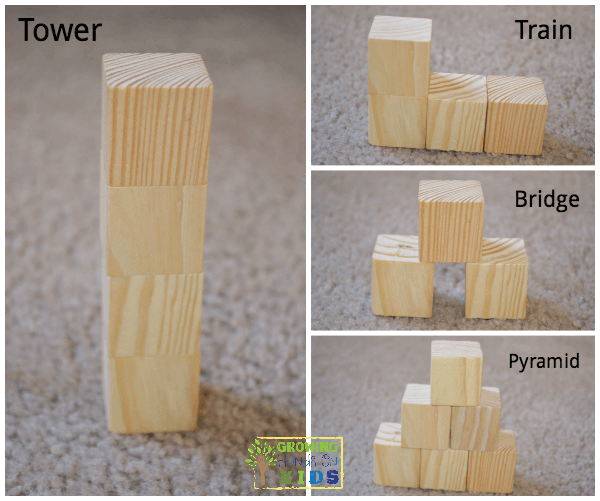
Builds a tower of 9+ blocks
Block play supports grasp strength, coordination, and creativity.
Try this:
- Build towers, roads, or houses
- Stack blocks by color or size
- Use small blocks to encourage a pincer grasp
Dresses and undresses with minimal help
Self-care skills build independence and sequencing.
Try this:
- Practice with dolls, stuffed animals, or paper dolls
- Use clothing with large buttons, snaps, or zippers
- Play “dress the bear” games
Feeds self with minimal spilling
Messy is normal—but control improves with practice.
Try this:
- Scoop dry foods like cereal or beans
- Use thick-handled utensils
- Practice pouring dry items between containers
Activity Ideas Ages 3½–4 Years
Pours from a small pitcher
This builds wrist control, strength, and coordination.
Try this:
- Pour water during bath time
- Transfer dry rice or beans between cups
- Carry small bins or weighted toys
Places small pegs into holes
This skill really challenges the pincer grasp.
Try this:
- Use pegboards or Lite-Brite
- Push toothpicks into play dough
- Open and close clothespins or clips
Strings small beads
This is great for bilateral coordination and midline crossing.
Tip: Encourage your child to use one hand consistently across the string.
Try this:
- Beading patterns by color
- Lacing cards
- Threading beads onto shoelaces
Holds a pencil with a tripod grasp
At this age, many children are still stabilizing with the forearm and wrist—and that’s okay.
Try this:
- Short crayons or broken chalk
- Vertical coloring on easels or walls
- Tracing simple shapes and paths
The goal isn’t perfection, it’s exposure, repetition, and playful practice. Small, everyday activities done often are far more effective than long, structured sessions.
You can find many more activity ideas in my book: Basics of Fine Motor Skills – Developmental Activities for Kids.
You May Also Like:

Heather Greutman, COTA
Heather Greutman is a Certified Occupational Therapy Assistant with experience in school-based OT services for preschool through high school. She uses her background to share child development tips, tools, and strategies for parents, educators, and therapists. She is the author of many ebooks, including The Basics of Fine Motor Skills, The Basics of Pre-Writing Skills, and co-author of Sensory Processing Explained: A Handbook for Parents and Educators.
I came across your site today through Pinterest. I am a retired music teacher, pleased to be a new grandmother! Also, I am teaching private piano to all ages, currently 4 yrs through 43 yrs. Your information is a wonderful and fresh view of developmental stages of preschoolers. It is a thrill to teach a few children at a time versus the 375+- K-5th graders that I taught by myself for years in the public schools. Bravo on a terrific web site.